
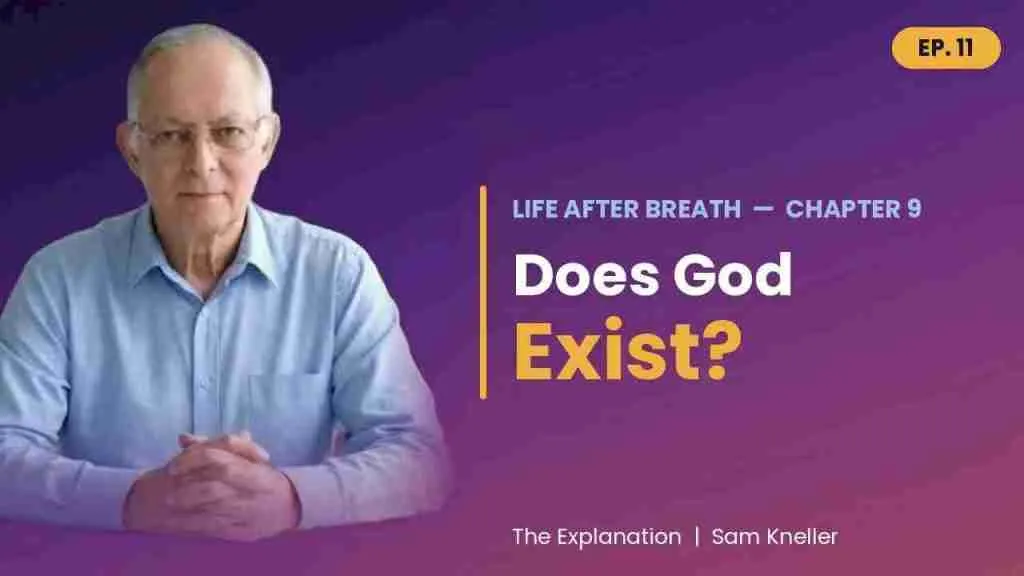
Elohim, the Bible’s most-used name for God, is grammatically plural — but the Old Testament stubbornly pairs it with a singular verb, like saying “They is” instead of “They are.” Chapter 9 of Life After Breath calls this the plural-singular paradox, and argues it isn’t a scribal slip. It’s the first clue to a relational God who turns out to be, in Jesus’ own words, “two who are one.”
This is Week 11 of a 52-week journey through Life After Breath: A Hitchhiker’s Guide to Consciousness — a new weekly series from The Explanation. Every Monday, a new chapter lands here, on YouTube, and in your inbox.
Chapter 8 used the Bible’s own four-step method to show that adam means “humanity,” not one man — settling who gets the neshama, the breath of life. Chapter 9 turns to the much bigger question hiding behind that same verse, Genesis 2:7: who, exactly, is “the LORD God” doing the breathing? The English flattens two enormous Hebrew clues — Yahveh (H3068) and Elohim (H430) — into one generic title, and untangling them is where the plural-singular paradox comes in.
This isn’t the first time The Explanation has tackled this question. An earlier piece, Does God Exist? Who is the Higher Power? What’s His Purpose?, walks through much of the same Genesis 1:26, Exodus 3:14, and Hebrews 1 territory under the MBPS banner. This week’s chapter makes a tighter version of that same case, but the real payoff isn’t just “God exists” — it’s what kind of God the grammar itself reveals once you notice the plural-singular paradox sitting in plain sight on page one.
Chapter 9: Does God Exist?
Word for word, from the book:
Alright, we’ve arrived at the million-dollar question: Does God exist? We’re not trying to prove it scientifically here—that’s impossible. Instead, we’re playing detective with the Bible, the book that claims to have all the answers. We’re looking for identifying signs to see if its description of God holds up.
In Genesis 2:7, the key characters are introduced: “humans” (which we now know means all humanity, adam) and “the LORD God.” But who is this “LORD God”? The English translation masks two massive clues in the original Hebrew: Yahveh (H3068) and Elohim (H430).
This is where it gets fascinating. The word Elohim is grammatically plural. It’s like the word “moose”—it can be singular or plural. But here’s the twist: even though it’s plural, it’s almost always used with a singular verb. It’s like saying “They is” instead of “They are.” This is a huge, intentional clue from the very first sentence of the Bible.
Why does this matter? Because in Genesis 1:26, this plural Elohim says, “Let us make mankind in our image.” The Bible itself confirms there’s an “us” and an “our” within the Godhead right from the start. This isn’t an editing error; it’s a central feature of the story.
So, if Elohim is plural, who is the singular “LORD” (Yahveh)? This name comes from the Hebrew verb “to be” (hayah). It means “The Eternal One” or “I AM.” This is the self-existent, everlasting God—the one who has always been and always will be. He confirms this to Moses in Exodus 3:14, famously saying, “I AM WHO I AM.” His name is His nature: eternal existence.
Now, how do we reconcile a plural “Elohim” with a singular “I AM”? The New Testament helps us connect the dots. It reveals that the “us” in Genesis includes God the Father and God the Son, Jesus Christ.
The book of Hebrews, chapter 1, spells it out:
- God spoke to us by His Son.
- The Son is the one “through whom also He made the worlds.”
- The Son is “the radiance of God’s glory and the exact representation of His being.”
This is mind-blowing. It tells us that God the Father (Elohim) carried out the work of creation through a second divine being (the Lord, “I AM”)—His Son. The Son is so perfectly united with the Father that He is the exact image of His essence. They are distinct (“Father” and “Son”) yet one (“us” and “our”).
Jesus Himself prayed about this unique relationship in John 17, asking that His followers “may be one, just as you, Father, are in me, and I am in you.” The model for ultimate unity is the relationship between the Father and the Son—two who are one.
So, what’s the picture forming?
- Elohim (The Plural Godhead): The unified family of divine beings, consisting of the Father and the Son.
- Yahveh (The Eternal “I AM”): This name encompasses the eternal, self-existent nature shared by both the Father and the Son. But it is used to refer to the Son.
This isn’t a contradiction; it’s a complexity that solves the puzzle. The “LORD God” (Yahveh Elohim) who formed humans from dust is the Son working with the Father in perfect harmony. The Son, as the “Word” (John 1:1-3) and active agent of creation, was the one who got His hands dirty, so to speak, shaping the first human and breathing the breath of life into him.
This changes everything. The Creator isn’t a distant, solitary force. He is a relational family. And if we are made in the image of this God, it explains our deep need for relationship, our capacity for love, and our inherent creativity. It also means that the “neshama” He breathed into us is a reflection of His own communal, intelligent, and purposeful nature.
We’re not just random biological machines. We are the intentional creation of a relational, eternal God. Our consciousness/neshama is a finite mirror of His infinite Being. This is the foundational truth that every other answer about our existence will be built upon.
The Breakthroughs Behind Chapter 9’s Case for God’s Existence
From Theology & Ontology (Nature of God): Resolves the Plural-Singular Paradox of God. The chapter’s central breakthrough is explaining the grammatical oddity of Elohim (a plural noun) consistently taking singular verbs in the Old Testament. It argues this is not an error but a precise revelation of a plural yet unified Godhead—a concept fully corroborated by the New Testament.
From Theology & Ontology (Nature of God): YHVH as the “I AM” of Ontology. It defines the name YHVH (LORD) not as a title but as an ontological statement based on the verb “to be” (H1961, hayah). This identifies God as the self-existent, eternal Being—the uncaused cause whose very nature is existence itself (“I AM THAT I AM”).
From Theology & Ontology (Nature of God): Distinguishes Roles within the Godhead. It uses Hebrews 1:1-2 to show a functional distinction within the unified Elohim: God the Father (the Majesty on high) and God the Son (the Creator and heir of all things). This presents a Biblically grounded, plural monotheism.
From Linguistics & Exegesis: Grammatical Proof of Divine Nature. It treats Hebrew grammar as a deliberate divine revelation. The plural Elohim with singular verbs and the use of plural pronouns (“Let Us make man”) are presented as foundational data points, not later theological additions.
From Linguistics & Exegesis: Reconciles “Two Creation Accounts”. It resolves the critical scholarship claim of contradictory Genesis accounts by showing Genesis 1 uses the plural Elohim (God) for the cosmic overview, while Genesis 2-3 uses the singular YHVH Elohim (LORD God) for the intimate, relational details with humanity. This is framed as intentional design, not editorial error.
From Philosophy: Answers the “First Cause” with a Person. The chapter provides a specific answer to the cosmological argument for God’s existence. The “First Cause” is not an abstract force but a personal, relational Being with a name (YHVH) and a complex, loving nature.
FAQ: The Plural-Singular Paradox
What is the plural-singular paradox in the Bible?
It’s the Hebrew grammatical oddity in Elohim (H430), the Bible’s most common name for God: the word is grammatically plural, like the English word “moose,” but the Old Testament almost always pairs it with a singular verb — “They is,” not “They are.” Chapter 9 of Life After Breath argues this isn’t a scribal error; it’s a deliberate, built-in clue to God’s nature, present from the very first sentence of Genesis.
Does Genesis 1:26 really say “us” and “our”?
Yes. When the plural Elohim speaks in Genesis 1:26 — “Let us make mankind in our image” — the Hebrew text itself uses plural pronouns for God. That’s the same plural-singular paradox showing up again: a single God speaking of Himself in the plural, long before any doctrine existed to explain why.
What does the name YHVH (Yahveh) actually mean?
YHVH comes from the Hebrew verb “to be” (hayah) and is best understood as “I AM” — the name God gives Himself to Moses in Exodus 3:14. It’s not a label; it’s a claim about His nature: self-existent, eternal Being. Chapter 9 uses this to show how the singular “I AM” and the plural Elohim resolve into one answer, not two competing ones.
How does the New Testament resolve the paradox?
Hebrews 1 and John 17 are the chapter’s two key texts. Hebrews 1 identifies the Son as the one “through whom also He made the worlds” and “the exact representation of His being”; John 17 has Jesus praying that His followers “may be one, just as you, Father, are in me, and I am in you.” Put together, they show the Genesis “us” was always God the Father and God the Son — two who are one, exactly what the plural-singular paradox had been signaling all along.
How do I follow along each week?
Subscribe to the weekly email to get each new chapter as it releases, or catch the video version on YouTube channel @theexplanation.
What’s Next
Chapter 9 resolves the plural-singular paradox into a relational God — Father and Son, two who are one. Next week, Chapter 10 picks up exactly where this leaves off: “Elohim is Plural. God is a Family” takes the same grammar one step further, into the claim that every human relationship is modeled on a family that already exists inside God Himself.
Want the full, scholarly original now instead of waiting a week at a time? Get Mind-Body Problem Solved.

Dig Deeper into The Explanation
Online Study Courses to Uncover the Mystery of Adam and Eve’s Nakedness… with no fuss. Free video mini-course revealing the God-intended meaning of Scripture via Biblical Hebrew. It’s so easy, it’ll blow you away. Join now and add new motivation to your Bible study.
Join The Explanation Newsletter to stay informed of updates. and future events. No obligations, total privacy, unsubscribe anytime, if you want.
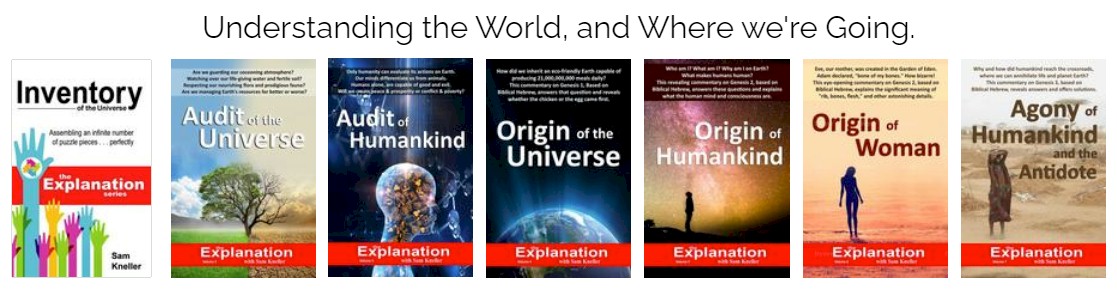
The Explanation series of seven books. Free to read online or purchase these valuable commentaries on Genesis 1-3 from your favorite book outlet. E-book and paperback formats are available. Use this link to see the details of each book and buy from your favorite store.
Since you read all the way to here… you liked it. Please use the Social Network links just below to share this information from The Explanation, The Plural-Singular Paradox: The Shocking Secret of 2 Who Are One God


Fascinating.
Where is the Holy Spirit?
Ron, thanks for your interest. The Holy Spirit is the power OF both the Father and the Son. For those with different beliefs, this is a hard one. A whole section of the book Life After Breath is devoted to the Holy Spirit, so it’s coming up. But you can read about it here, more elaborately, in Mind-Body Problem Solved. https://theexplanation.com/read-content-of-mind-body-problem-solved-online/ Section 4, Chapter 21. It’s also available on video https://www.youtube.com/watch?v=ImCUw2mIcL8&list=PLVXMRd9z3XUk7MbwX5O62yEotWzs-Q3sq starting with #23. Your feedback and questions after reading/watching are of value to me.