
You don’t need fluent Hebrew to read the Bible the way it was meant to be read. Chapter 7 of Life After Breath hands you the actual tool — free, online, four steps — and walks it through the book’s own flagship word so you can see exactly how it works.
Life After Breath, Chapter 7: Biblical Hebrew Revolutionary Study Method
This is Week 9 of a 54-week journey through Life After Breath: A Hitchhiker’s Guide to Consciousness — a new weekly series from The Explanation. Every Monday, a new chapter lands here, on YouTube, and in your inbox.
For six chapters, this series has built the case that science, philosophy, religion, and plain human reasoning all strike out trying to explain the mind — and that theology, read as the logical study of God rather than inherited religious tradition, is the only approach left standing. Chapter 7 stops arguing for theology and starts practicing it. It hands you the actual Biblical Hebrew revolutionary study method — a free, repeatable, four-step process — and walks it through the book’s own flagship word, live, on a real website.
This isn’t new ground for The Explanation — an earlier piece covers much of the same four-step process using the same word: here’s the original MBPS-era walkthrough of the method. This week’s chapter tells the same story inside the fuller Life After Breath argument, using it as the hinge that turns six chapters of “no explanation” into an actual method for finding one.
Chapter 7: Biblical Hebrew Revolutionary Study Method
Word for word, from the book:
Let’s get straight to it. You want to know what the Bible really means, especially about big ideas like consciousness and mind? The quickest way to unlock its original, God-intended meaning isn’t by learning fluent Hebrew—it’s by mastering a simple method for understanding its key words. And the best part? All the tools are free online, and it’s easier than you think.
We’re going to use a website called UnlockBibleMeaning.com. It’s a free toolkit that does the heavy lifting for us. Let’s start with a famous verse: Genesis 2:7, which says God “breathed into his nostrils the breath of life.”
Now, pull up that verse on the site and switch to the “Interlinear” view. This shows you the English right below the original Hebrew. You’ll immediately see something weird. The English uses the word “breath” twice: “breathed” and “breath.” But look at the Hebrew words above them. They’re completely different!
The tools will show they are Strong’s numbers H5301 (napach, meaning “to blow”) and H5397 (neshama, meaning “breath”). The same English word is masking two totally different Hebrew ideas. This is the core of the problem with any translation.
Let’s dig deeper. Search for the phrase “breath of life” in the Bible. You’ll find it in four places. But when you check the Hebrew, you’ll find it’s translated from three different words: H5397 (neshama), H5301 (napach), and H7307 (ruach, which often means “spirit” or “wind”). This isn’t a minor issue; this is a massive translation anomaly hiding in plain sight in one of the most fundamental concepts of what a human is. No wonder there’s so much confusion!
So, here’s the simple 4-step Biblical Hebrew revolutionary study method we’ll use to cut through this mess and find the original meaning:
One for All: Accept that one Hebrew word can have multiple English meanings. Our word neshama (H5397) is translated as “blast,” “breath,” “inspiration,” “soul,” and “spirit.” It’s not a one-to-one match. The original word is a rich concept that no single English word can capture.
Figurative Meanings: Understand that the physical meaning is often just the tip of the iceberg. “Breath” is physical. But “inspiration” and “spirit” are invisible, figurative ideas. 90% of the word’s deeper meaning is hidden below the surface, like the huge part of an iceberg underwater. If you only see the physical “breath,” you’re missing almost the entire point.
Root Meanings: Every Hebrew word is built on a root, usually three letters. Click on neshama (H5397) and you’ll see it comes from the root nasham (H5395). And here’s the plot twist: the root H5395 means “to destroy.” Wait, what? So the “breath of life” comes from a root that means “to blow away” or “destroy”? That seems like a massive contradiction. This is exactly the kind of paradox we have to solve.
All for One: This is the final step. Your job is to take ALL the meanings—the multiple translations, the figurative ideas, and even the seemingly contradictory root—and weave them into one coherent story. Every Hebrew word tells a single, unified story. Your goal is to find the narrative that perfectly connects “breath,” “spirit,” “inspiration,” and even “destroy” into a concept that makes perfect sense.
This method treats each word like a unique puzzle piece. The different meanings show you the shape of the piece. When you finally understand its one story, you’ll know exactly where it fits in the grand puzzle of the Bible’s message. This is how we move from confusion to “coherent completeness”—and finally get a clear definition of the mind, body, and consciousness from the source that claims to have created them.
The Breakthroughs Behind Chapter 7’s Biblical Hebrew Revolutionary Study Method
From Theology & Hermeneutics: Democratizes Deep Biblical Understanding. It presents a method that bypasses the need for years of formal Hebrew scholarship, claiming anyone can access the original “God-intended meaning” in minutes using free online tools (e.g., UnlockBibleMeaning.com). This dismantles the traditional gatekeeping of academic or institutional theology.
From Theology & Hermeneutics: The Biblical Hebrew Revolutionary Study Method in 4-Steps“. It formalizes a replicable, systematic process for exegesis: Step 1: One for All — Acknowledge one Hebrew word has multiple English translations, even contradictory meanings. Step 2: Figurative Meanings — Identify the hidden, often non-physical, definitions (the “9/10 of the iceberg”). Step 3: Root Meanings — Trace the word to its primitive root, often revealing paradoxical or deeper meanings. Step 4: All for One — Synthesize all meanings into one coherent story that reflects divine logic.
From Theology & Hermeneutics: Reveals Translation as Interpretation. It proves that every Bible translation is an interpretation by showing how one English word (“breath” in Gen. 2:7) translates three different Hebrew words (H5301, H5397, H7307), obscuring the original meaning.
From Linguistics & Semantics: The “Coherent Story” Principle of Words. It argues that every Biblical Hebrew word is a “puzzle piece” whose multiple—sometimes contradictory—meanings (e.g., neshama meaning both “breath” and “destroy”) are not errors but deliberate contours that, when understood, tell a single, divine story.
From Linguistics & Semantics: Validates Paradox as Divine Communication. The chapter reframes apparent contradictions in word meanings (e.g., a life-giving breath that also means destruction) not as problems to be solved, but as the very key to understanding deeper spiritual truths.
From Psychology of Learning: Overcomes “Semantic Satiation.” It counteracts the tendency for familiar terms (e.g., “breath of life”) to lose meaning by breaking them down into unfamiliar Hebrew components, re-engaging the reader’s curiosity and analytical thinking.
FAQ: The 4-Step Biblical Hebrew Revolutionary Study Method
What is this chapter’s 4-step Hebrew word study method?
It’s the four-step process Chapter 7 walks through live on UnlockBibleMeaning.com: One for All (accept a Hebrew word can carry several English translations), Figurative Meanings (find the non-physical sense hiding beneath the literal one), Root Meanings (trace the word to its three-letter root), and All for One (weave every meaning, even the contradictory ones, into one coherent story). It’s built to work on any Hebrew word in Scripture, not just the one used as the example here.
Do I need to learn Hebrew to use this method?
No. That’s the entire point of this approach — it’s designed for readers with zero Hebrew training. Every step happens inside a free website, UnlockBibleMeaning.com, which surfaces the Hebrew text, the Strong’s numbers, and the root word for you. You’re reading tools, not translating a foreign language from scratch.
Why does neshama have so many different English translations?
Because neshama (H5397) isn’t a single, narrow concept the way an English word usually is — it’s translated as “blast,” “breath,” “inspiration,” “soul,” and “spirit” depending on context. Chapter 7’s Step 1, One for All, is built specifically to stop readers from assuming a one-to-one match exists where it doesn’t.
What does it mean that neshama’s root word means “to destroy”?
Neshama traces back to the three-letter root nasham (H5395), which means “to destroy” or “to blow away” — a jarring contradiction for a word that also means “breath of life.” Chapter 7 treats this not as an error in the text but as a deliberate paradox that Step 4, All for One, is designed to resolve into a single coherent story.
Where can I actually try this method myself?
UnlockBibleMeaning.com is free and open to anyone, 24/7 — the same tool used throughout this chapter to look up Genesis 2:7, pull the Strong’s numbers, and trace the root. Subscribe to the weekly email to get each new chapter as it releases, or catch the video version on YouTube channel @theexplanation.
What’s Next
This is chapter nine of fifty-two. Chapter 7 hands you the method; next week, Chapter 8 turns it on one of the Bible’s most explosive debates — does Genesis 2:7’s “man” really mean just Adam? — and asks what this same four-step approach reveals about men and women’s equality in the text itself.
Want the full, scholarly original now instead of waiting a week at a time? Get Mind-Body Problem Solved.
Want the full, scholarly original now instead of waiting a week at a time? Get Mind-Body Problem Solved.

Dig Deeper into The Explanation
Online Study Courses to Uncover the Mystery of Adam and Eve’s Nakedness… with no fuss. Free video mini-course revealing the God-intended meaning of Scripture via Biblical Hebrew. It’s so easy, it’ll blow you away. Join now and add new motivation to your Bible study.
Join The Explanation Newsletter to stay informed of updates. and future events. No obligations, total privacy, unsubscribe anytime, if you want.
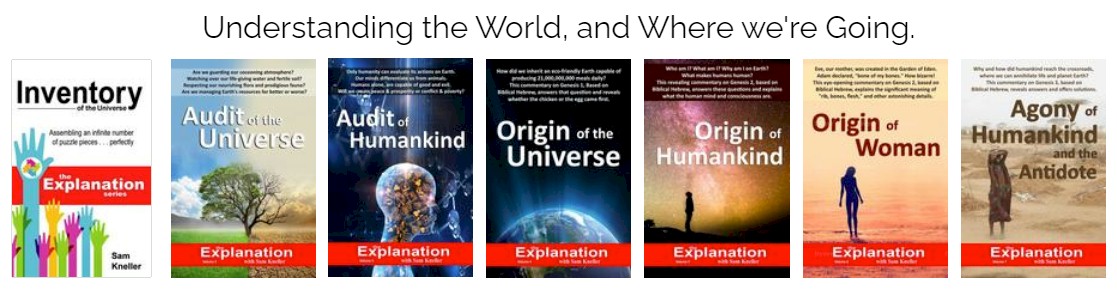
The Explanation series of seven books. Free to read online or purchase these valuable commentaries on Genesis 1-3 from your favorite book outlet. E-book and paperback formats are available. Use this link to see the details of each book and buy from your favorite store.
Since you read all the way to here… you liked it. Please use the Social Network links just below to share this information from The Explanation, Biblical Hebrew Revolutionary Study Method: The Shocking Breakthrough in Just 4 Steps
Let’s Connect!