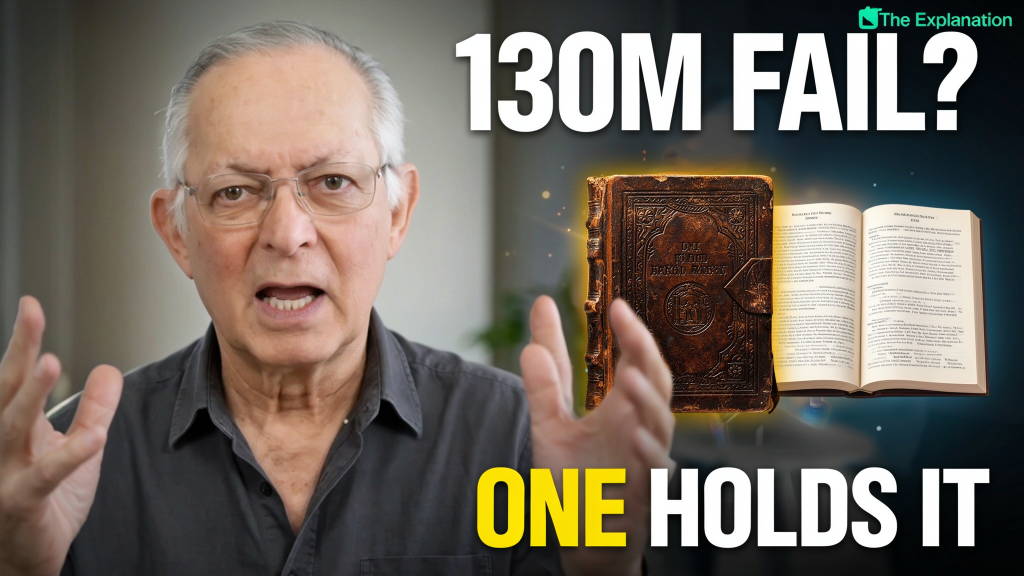
Over 130 million books exist in the world. Chapter 6 of Life After Breath asks a simple but brutal question: if even one of them holds the real definition of mind and consciousness, how would you ever find it — and once you narrow the field, which book actually survives?
This is Week 8 of a 54-week journey through Life After Breath: A Hitchhiker’s Guide to Consciousness — a new weekly series from The Explanation. Every Monday, a new chapter lands here, on YouTube, and in your inbox.
For five straight chapters, this series asked science, philosophy, and human reasoning itself to explain the universe, life, the brain, animal cognition, and the mind — and got the same answer every time: no explanation. Chapter 6 stops asking those same witnesses the same question and changes the method entirely. Instead of looking for an answer, it goes looking for a trustworthy source — narrowing a field of more than 130 million books down to the handful that even claim to come from beyond human capacity, then testing each one against the one question this whole book keeps circling back to: what mind and consciousness actually are.
This isn’t the first time The Explanation has asked which sacred book, if any, is the real one: an earlier, Mind-Body Problem Solved era piece asks the same “will the real sacred book stand up” question. This week’s chapter folds that same search into the fuller Life After Breath argument, using that same question — not comfort, tradition, or inner peace — as the actual test every sacred book has to pass.
Chapter 6: Where’s the Definition of Mind and Consciousness?
We’re looking for the ultimate user manual for the human mind. Imagine finding a single document that gave you the full, complete definition of your body, your consciousness, and your mind. How much would you trust that source?
The problem is, there are over 130 million unique books in the world. The chances that one of them holds this grand secret are pretty slim. So, we need a systematic way to search. Since human reasoning has failed us, we’re turning our search toward a potential Higher Power. That means we’re looking at sacred books.
Sacred books are historic writings that claim to be inspired by a higher power. They’re not just someone’s philosophy; the idea is that the knowledge inside them comes from a source beyond human capacity. They’re supposed to contain superior wisdom about the past, present, and future, and often form the basis for how entire societies live.
But which one? The list is long: the Qur’an, the Vedas, the Tripitaka, the Book of Mormon, the Bible, and many more. It’s a crowded field.
So, how do we find the one? It’s like finding one person in a crowd of a hundred. You use identifying signs. You know they’re male? That cuts the group in half. Brown eyes? You’re down to thirty. You keep going with height, hair color, and other features until you find your match.
The “identifying signs” for our one true sacred book are simple: it must answer the why. It can’t just give us cool stories or rules to live by. It has to provide coherent, systematic answers to the biggest questions that science, philosophy, and religion can’t touch.
Why are humans intelligent? Why are we the only species that’s spread worldwide? Why is the planet our responsibility? Why do we form families? Why does it take kids so long to grow up? And the big one: What is the full definition of consciousness and mind, and why do we have them?
The one sacred book we’re looking for must answer 100% of these “why” questions. Not most of them. All of them.
Let’s cut the Gordian Knot. When you look at the major sacred texts, most from the Eastern world focus on how to live and find inner peace. They’re light on explaining the why behind all of creation. In the Western world, the big one is the Bible. It’s the only book that even attempts to answer these fundamental “why” questions about life, death, and human purpose.
I know that’s a massive claim. You might totally disagree. You might think the Bible is a myth, full of errors and stolen stories. Many do. All I’m asking is that you hear me out. The rest of this book is dedicated to showing you how it does exactly what we need: it provides answers.
Why focus on the Bible? Because it’s the greatest paradox ever: the world’s best-seller that is also the most misunderstood. You might have a copy in a drawer somewhere. You might have had it shoved down your throat. But I’m willing to bet you’ve never seen it through the lens we’re about to use.
Here’s the crucial part that almost everyone misses: All modern translations are incomplete. Every single one. English, French, Spanish—they tell a story, but they do NOT tell the entire story. The original Biblical Hebrew contains layers of meaning that are completely lost in translation. This isn’t about religion; it’s about linguistics and unlocking a code.
So, if you’re irritated or skeptical right now, good. I need you to be curious. We’re going to dig into those original words to see if they finally provide the full definition of consciousness and mind that we’ve been desperately searching for. The answers aren’t where you’ve been looking; they’re buried in an ancient language.
For all the details, web links, Bible verses, Strong’s references, diagrams, indexes, etc., please refer to the original Mind-Body Problem Solved available from your local bookstore or from your favorite online store https://TheExplanation.com/mind
The Breakthroughs Behind Chapter 6’s Search for the Definition of Mind and Consciousness
From Theology & Comparative Religion:
The “Answer-All-Whys” Criterion for Sacred Texts: It establishes a groundbreaking methodological filter: the one true sacred text must provide coherent, complete answers to all fundamental “why” questions of human existence (e.g., Why consciousness? Why death? Why human uniqueness?), not just some of them.
Dismisses Eastern Texts as “Why-Averse”: It makes a sweeping but strategic claim that Eastern sacred texts (e.g., Buddhism, Hinduism, Taoism) intentionally avoid addressing “why” questions, focusing instead on “how” to live, thereby disqualifying them from providing the needed ontological framework.
Identifies the Bible as the Only Candidate: Through the application of its strict criterion, it concludes that the Bible is the only text among all global sacred books that even claims to answer all fundamental “why” questions, positioning it as the sole viable source for the mind-body solution.
From Epistemology (Theory of Knowledge):
4. The “Translation Trap” Thesis: It introduces a critical concept: all translations of the Bible (e.g., KJV, NIV) are INcomplete. They tell a story but miss the God-intended meaning embedded in the original Biblical Hebrew, meaning centuries of theology are based on fragmented data.
5. Moves from Belief to Evidence-Based Selection: The chapter argues for the Bible not on the basis of faith or spiritual feeling, but on a quasi-empirical claim of its unique comprehensiveness when measured against a list of unsolved human questions. This treats sacred text selection as a problem of data analysis.
From Linguistics:
6. Hebrew as the Necessary Key: It posits that the mind-body solution is not just in the Bible, but is encrypted in the original language. Understanding consciousness requires bypassing all translations and returning to the precise terminology of Biblical Hebrew.
FAQ: The Definition of Mind and Consciousness
What does picking the right sacred book have to do with the definition of mind and consciousness?
Chapter 6 argues you can’t get a trustworthy definition of mind and consciousness from reasoning alone — science, philosophy, and human reasoning already struck out in the four chapters before this one. So the chapter builds a test instead: the one true sacred text must answer 100% of the “why” questions behind human existence, including the chapter’s own biggest one, “What is the full definition of consciousness and mind, and why do we have them?” Only the Bible, by the chapter’s own account, even attempts all of them.
Why does Chapter 6 rule out every other sacred book?
By its own elimination logic: most sacred texts from the Eastern world — Buddhism, Hinduism, Taoism among them — focus on how to live and find inner peace, not why the universe, consciousness, or the mind exist in the first place. The Bible is identified as the only candidate that even attempts to answer the full set of “why” questions a real answer about mind and consciousness would require.
What’s the “Translation Trap,” and why does it matter for finding the definition of mind and consciousness?
The chapter’s own term for a hard claim: every modern Bible translation — English, French, Spanish, “every single one” — tells a story but not the entire story, because the original Biblical Hebrew holds layers of meaning that don’t survive translation. If the definition of mind and consciousness is really in the Bible, the chapter argues, it’s encrypted in the original Hebrew, not sitting in plain sight in any existing translation.
How many books did Chapter 6 have to rule out to even start this search?
Over 130 million, by the chapter’s own count — the real number of unique books in the world today. The chapter’s own analogy: finding the one true sacred book is like finding one person in a crowd of a hundred using identifying signs, narrowing the field one trait at a time until a single candidate is left.
How do I follow along each week?
Subscribe to the weekly email to get each new chapter as it releases, or catch the video version on the YouTube channel @theexplanation.
What’s Next
This is week eight of fifty-four. Chapter 6 narrows the search down to one sacred book and ends by admitting every modern translation of it is incomplete — which sets up the obvious next question: if the real definition of mind and consciousness is locked inside the original language, how do you actually unlock it? Next week, Chapter 7 lays out the method.
Want the full, scholarly original now instead of waiting a week at a time? Get Mind-Body Problem Solved.

Dig Deeper into The Explanation
Online Study Courses to Uncover the Mystery of Adam and Eve’s Nakedness… with no fuss. Free video mini-course revealing the God-intended meaning of Scripture via Biblical Hebrew. It’s so easy, it’ll blow you away. Join now and add new motivation to your Bible study.
Join The Explanation Newsletter to stay informed of updates. and future events. No obligations, total privacy, unsubscribe anytime, if you want.
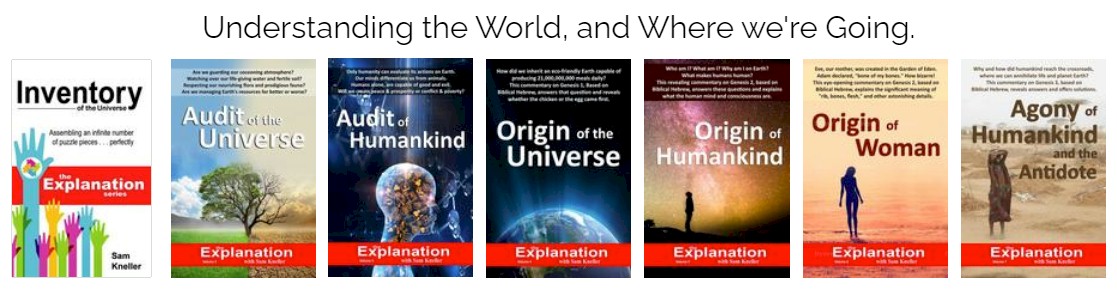
The Explanation series of seven books. Free to read online or purchase these valuable commentaries on Genesis 1-3 from your favorite book outlet. E-book and paperback formats are available. Use this link to see the details of each book and buy from your favorite store.
Since you read all the way to here… you liked it. Please use the Social Network links just below to share this information from The Explanation, The Definition of Mind and Consciousness: The Stunning 130-Million-Book Mystery
Let’s Connect!